

IMKANAT (Jul-Sep 2026)
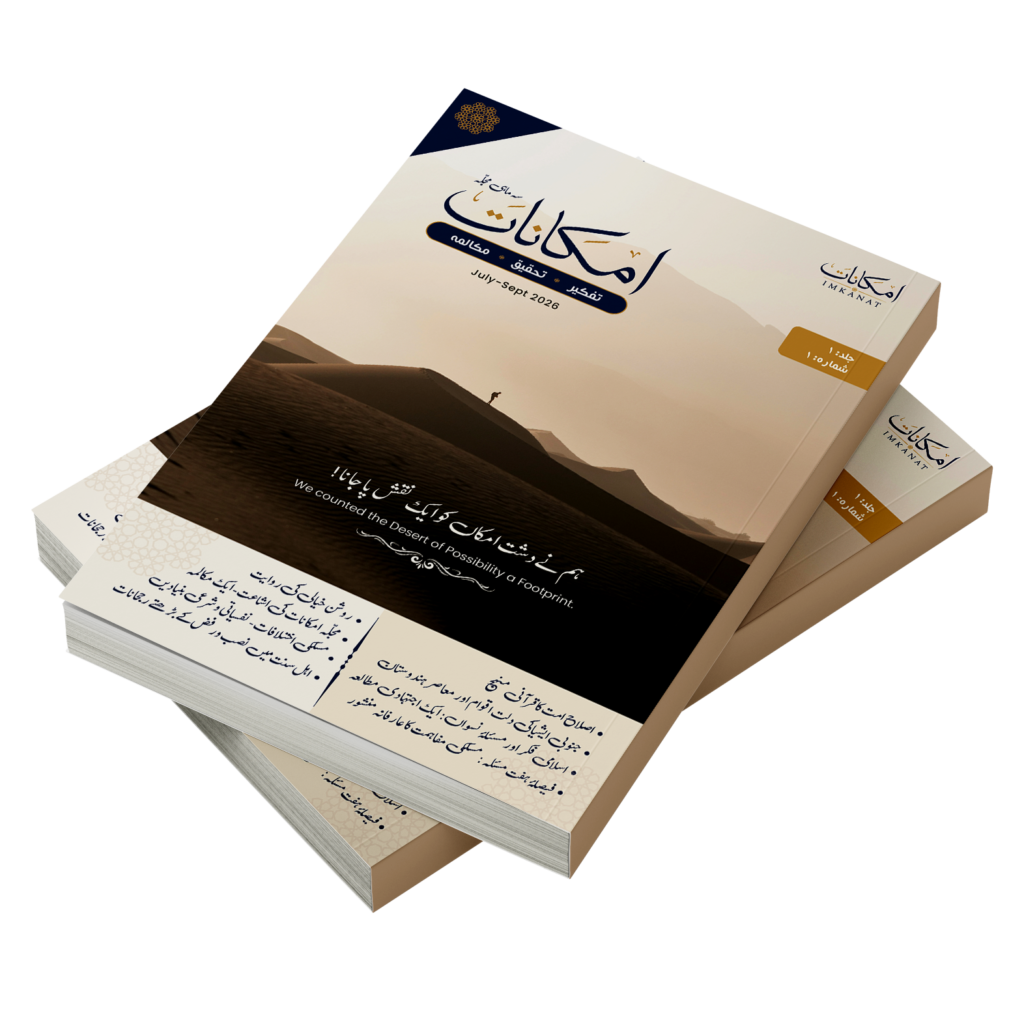
- Freedom of Thought: Dr. Syed Noor Muhammad Lakhnawi’s poem champions intellectual freedom and independent research.
- Religious Intolerance: An exclusive interview with Prof. Dr. Syed Shamimuddin Ahmad Manami examines the roots of intolerance and sectarian rigidity.
- Ethics of Reform: Maulana Mansoor Alimi explores the Qur’anic ethics of reform and the moral responsibility of reformers.
- Enlightenment & Youth: Dr. Muhammad Ali examines the tradition of Enlightenment and its relevance to developing critical thinking among young people.
- Sectarian Disagreements: Dr. Jalees Akhtar Naseeri and Maulana Nazim Ashraf Misbahi explore the causes and consequences of sectarian polarization.
- Islamic Thought & Social Questions: Dr. Waris Mazhari examines the question of women in Islamic thought, while Ahmad Javed explores the condition of Dalit communities in contemporary India.
- Reconciliation & Educational Reform: The issue revisits Faisla-e-Haft Mas’ala as a resource for sectarian reconciliation and examines the integration of religious and modern education in Indian madrasas.
Introduction
IMKANAT (امکانات) makes its debut with this first issue at a time when the intellectual, religious, social, and educational landscape around us demands renewed attention, honest inquiry, and meaningful dialogue. The purpose of IMKANAT is not merely to present articles on diverse subjects, but to create a space where ideas can be examined freely, differences can be discussed with dignity, and contemporary questions can be approached through both intellectual openness and a serious engagement with tradition.
The first issue reflects this vision through a wide range of contributions addressing some of the most pressing questions of our time: freedom of thought, the ethics of reform, sectarian disagreements, Islamic intellectual thought, the question of women, the condition of marginalized communities in India, and the relationship between religious and modern education.
The issue opens with Dr. Syed Noor Muhammad Lakhnawi’s poem, “Why Does the Companion Turn Away from the Word of Wisdom?”—a powerful expression of concern over restrictions placed upon independent thought and research. The poem sets the intellectual tone of this issue: knowledge requires the freedom to question, investigate, disagree, and explore.
Our Dialogues section carries this spirit forward through reflections from scholars and intellectuals on the publication of IMKANAT itself. Their observations and suggestions are part of an effort to establish the journal as a platform for sustained intellectual conversation.
A major feature of this issue is our interview with Professor Dr. Syed Shamimuddin Ahmad Manami, which explores the causes of intolerance and increasing harshness within religious and spiritual circles. Addressing the tendency for legitimate disagreement to descend into abuse, denunciation, and mutual exclusion, Dr. Manami points towards the role of education in shaping intellectual temperament. His observation that an excessively sectarian educational discipline can contribute to rigidity, and that multidisciplinary education may help cultivate greater openness, raises an important question about the future of religious education.
The question of reform is examined by Maulana Mansoor Alimi in his article, “The Qur’anic Ethics of Reforming the Ummah.” He argues that reformers often seek to reform society without first embodying the ethical principles through which the Qur’an itself teaches reform. The article therefore shifts attention from merely demanding reform to examining the moral character and methods of those who undertake it.
In “The Tradition of Enlightenment,” Dr. Muhammad Ali explores the intellectual tradition of Enlightenment and its relevance to the formation of a scholarly temperament among the younger generation. The article may invite disagreement on certain points, but its significance lies precisely in its attempt to stimulate critical thought and encourage readers to engage with ideas rather than merely accept inherited conclusions.
The growing problem of sectarian polarization is addressed from different perspectives. Dr. Jalees Akhtar Naseeri examines the emerging tendencies of nasb and rafd within Sunni discourse and warns of the possibility of these tendencies becoming a new source of prolonged internal conflict. Complementing this discussion, Maulana Nazim Ashraf Misbahi, in “The Psychological and Shar‘i Foundations of Sectarian Disagreements,” explores both the psychological and religious foundations of sectarian disputes and emphasizes the importance of distinguishing between fundamental and subsidiary matters while maintaining proper intellectual and ethical conduct.
Questions of tradition and contemporary thought are further explored in Dr. Waris Mazhari’s “Islamic Thought and the Question of Women: An Ijtihadic Study.” The article approaches the question of women through an ijtihadic framework and places a number of serious questions before contemporary Islamic scholarship. It reflects the need to engage contemporary realities without abandoning intellectual seriousness or the resources of the Islamic tradition.
Moving beyond internal religious debates, Ahmad Javed’s research paper, “The Dalit Communities of South Asia and Contemporary India,” examines the historical and contemporary condition of Dalit communities and other marginalized groups in India. By bringing questions of social exclusion, historical consciousness, and the growing tensions between Dalit communities and Manuvadi forces into focus, the article widens the intellectual scope of this issue and reminds us that serious scholarship must also engage with the social realities surrounding us.
The issue also revisits the history of sectarian reconciliation through a study of Haji Imdadullah Muhajir Makki’s Faisla-e-Haft Mas’ala. The work is presented as an important early attempt at developing a spirit of reconciliation amid the emerging Deobandi–Barelvi disagreements. Its emphasis on moderation and fairness remains relevant to contemporary discussions of sectarian conflict, particularly when texts are too often read selectively and outside their broader context.
Finally, the question of education receives attention through the volume “The Integration of Religious and Modern Education in Indian Madrasas: Possibilities and Challenges,” edited by Professor Safia Amir, Dr. Waris Matin Mazhari, and Dr. Najm-us-Sahar. The collection, originating from a seminar at Jamia Hamdard, New Delhi, examines the possibilities and challenges of bringing religious and modern education into meaningful dialogue. Dr. Jahangir Hasan Misbahi’s critical assessment of the volume in our Criticism and Review section adds another dimension to this discussion.
Taken together, the contributions to Issue 1 of IMKANAT are united by a common concern: how can we cultivate a culture of thought that is intellectually free, ethically responsible, historically conscious, and capable of engaging disagreement without turning it into hostility?
We do not expect every reader to agree with every argument presented here. Nor do we believe that intellectual dialogue requires uniformity. On the contrary, IMKANAT seeks to preserve the space in which disagreement can become a source of learning rather than division.
This first issue is therefore both a beginning and an invitation—an invitation to question, to listen, to examine inherited assumptions, and to explore the possibilities that emerge when scholarship is accompanied by openness and intellectual courage.
This is the spirit in which we present the first issue of IMKANAT: as a modest beginning, and as an open space for thought, dialogue, and new possibilities.